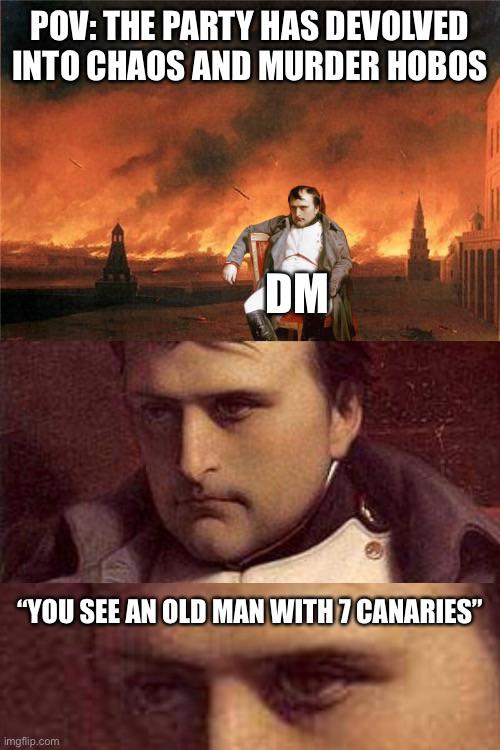
So I have played 1 campaign with my brother and listened to a bunch of DND podcasts, I know how the game works but i’m not super familiar with the lore, whats the punchline here?
In some lore, a God named Bahamut exists. He’s generally a good guy. He occasionally goes on strolls through the material planes in the disguise of an old man. He takes his posse of 7 Ancient Gold Dragons with him in the form of 7 Canaries.
People pick on the old man because it’s just an old man with some birds. Then the old man unfolds into what is arguably THE good God in a lot of DnD lore (or at least the primary good God) with 7 immensely powerful creatures that start maxing out the challenge ratings.
The likelihood of surviving this encounter are very very very very slim. People talk about terrasques all the time. Giant mountain sized monsters but no. This is how you get annihilated.
So if you want your players to start RPing better (yikes that autocorrect) and playing more heroic people, you have the wrathful god spare them at the last moment or resurrect them with the threat of following through next time they meet if they don’t shape up? Or is this just a good way to wipe the board with a good ol’ TPK?
TPK. If you’ve gotten to this point then you’ve tried everything. At that point it’s just time to cleanse the board with holy fire because nothing is going to save it.
Practically speaking, yes, 99.99999% of creatures wouldn’t last a literal second against Bahamut, but gods in the Faerun pantheon are not omnipotent, or invincible. He could be harmed or even killed, but there are very few creatures who could do it. A large party of level 20 adventurers could possibly pull it off, but at that level they’re effectively demigods in their own right.
Or Ao could just decide to replace him or give his portfolio to another lawful good god, snap his fingers, and even Bahamut would instantly pop out of existence.
They’d also probably need to prep for it, including some sort of method for pinning Bahamut down so they can actually force the fight. Otherwise it’s a fight that Bahamut chooses.
I was in a campaign some years back where the ultimate goal was to defeat a god. To “warm us up” the DM arranged partway through the campaign for us to get into a vendetta with a lesser demon, and it proved rather illuminating. When we went to fight it in its lair it creamed us because it had been preparing specifically to fight us, we barely teleported out with our lives. Then when we sat down together and started planning how to make another attempt, it teleported into our lair (a mansion owned by an NPC ally) and attacked us. We were like, “how dare it scry-and-fry us while we were preparing to scry-and-fry it!?”
Many high-level monsters have high intelligence scores, if the DM actually accounts for that then they can be almost arbitrarily powerful.
When we eventually went to fight the final boss god we came loaded for bear, we had something like 8 different supernatural armies on our side and we dropped an artifact superweapon on the god’s domain as the opening salvo. It was still a mighty slog, though, and at that point in the campaign Balors were essentially considered just “footsoldiers” against our party.
Not necessarily. Bahamut himself was known to spar with his followers in his true dragon form to prove their worth. While it’s highly unlikely, it’s entirely possible to destroy him on his home plane. No god in the Faerunian pantheon is completely immortal or invincible, in fact a fair number are mortals ascended to godhood. Bhaal, Bane, and Myrkul were mortals who l killed a primordial god, then traveled to the domain of Jergal, the original god of death, to kill him. He instead offered his three portfolios to them, ascending them to godhood. Bhaal was later slain by the mortal Cyric who then took over his portfolios and ascended to godhood. Gods in Faerunian pantheon are not omnipotent or omniscient.


So I have played 1 campaign with my brother and listened to a bunch of DND podcasts, I know how the game works but i’m not super familiar with the lore, whats the punchline here?
In some lore, a God named Bahamut exists. He’s generally a good guy. He occasionally goes on strolls through the material planes in the disguise of an old man. He takes his posse of 7 Ancient Gold Dragons with him in the form of 7 Canaries.
People pick on the old man because it’s just an old man with some birds. Then the old man unfolds into what is arguably THE good God in a lot of DnD lore (or at least the primary good God) with 7 immensely powerful creatures that start maxing out the challenge ratings.
The likelihood of surviving this encounter are very very very very slim. People talk about terrasques all the time. Giant mountain sized monsters but no. This is how you get annihilated.
It’s all about that action economy. Survive a terrasque hit (or hits in the case of multiattack)? No problem. Survive 8 terrasque hits? Problems.
So if you want your players to start RPing better (yikes that autocorrect) and playing more heroic people, you have the wrathful god spare them at the last moment or resurrect them with the threat of following through next time they meet if they don’t shape up? Or is this just a good way to wipe the board with a good ol’ TPK?
TPK. If you’ve gotten to this point then you’ve tried everything. At that point it’s just time to cleanse the board with holy fire because nothing is going to save it.
deleted by creator
Practically speaking, yes, 99.99999% of creatures wouldn’t last a literal second against Bahamut, but gods in the Faerun pantheon are not omnipotent, or invincible. He could be harmed or even killed, but there are very few creatures who could do it. A large party of level 20 adventurers could possibly pull it off, but at that level they’re effectively demigods in their own right.
Or Ao could just decide to replace him or give his portfolio to another lawful good god, snap his fingers, and even Bahamut would instantly pop out of existence.
No, they could kill an avatar of Bahamut, but not Bahamut itself.
They’d also probably need to prep for it, including some sort of method for pinning Bahamut down so they can actually force the fight. Otherwise it’s a fight that Bahamut chooses.
deleted by creator
I was in a campaign some years back where the ultimate goal was to defeat a god. To “warm us up” the DM arranged partway through the campaign for us to get into a vendetta with a lesser demon, and it proved rather illuminating. When we went to fight it in its lair it creamed us because it had been preparing specifically to fight us, we barely teleported out with our lives. Then when we sat down together and started planning how to make another attempt, it teleported into our lair (a mansion owned by an NPC ally) and attacked us. We were like, “how dare it scry-and-fry us while we were preparing to scry-and-fry it!?”
Many high-level monsters have high intelligence scores, if the DM actually accounts for that then they can be almost arbitrarily powerful.
When we eventually went to fight the final boss god we came loaded for bear, we had something like 8 different supernatural armies on our side and we dropped an artifact superweapon on the god’s domain as the opening salvo. It was still a mighty slog, though, and at that point in the campaign Balors were essentially considered just “footsoldiers” against our party.
Not even high level. Everyone’s heard of Tucker’s Kobolds.
Not necessarily. Bahamut himself was known to spar with his followers in his true dragon form to prove their worth. While it’s highly unlikely, it’s entirely possible to destroy him on his home plane. No god in the Faerunian pantheon is completely immortal or invincible, in fact a fair number are mortals ascended to godhood. Bhaal, Bane, and Myrkul were mortals who l killed a primordial god, then traveled to the domain of Jergal, the original god of death, to kill him. He instead offered his three portfolios to them, ascending them to godhood. Bhaal was later slain by the mortal Cyric who then took over his portfolios and ascended to godhood. Gods in Faerunian pantheon are not omnipotent or omniscient.
Its a god with 7 dragons
thank