

272·
1 day ago“a half is one-third more than a third” should mean either
1/3 + 1/3 = 1/2
Or
1/3 + (1/3 × 1/3) = 1/2
Neither of which is true.
Formerly /u/Zagorath on the alien site.
“a half is one-third more than a third” should mean either
1/3 + 1/3 = 1/2
Or
1/3 + (1/3 × 1/3) = 1/2
Neither of which is true.

If you’re Australian, Bali.

Okay but they often don’t give users what they want
You should see the state of Firefox on iPad OS. I started using it earlier this year after they finally rolled out support for multiple windows—a feature Safari added in 2019 and Chrome had only a few months later.
Nice that they finally have this feature, but the browser itself is nearly unusable. It stutters constantly and freezes, locks up, or force reloads with some regularity. In a way that Chrome and Edge (and I assume Safari, though I have never really used that) never do.
Or on desktop OSes, a website I frequented around 2016–2018 used the column-span CSS property, which Firefox didn’t get around to implementing until December 2019.
It’s been very clear for some time that, whether it’s because they stretch themselves too thin or some other reason, Mozilla has been failing to continue to deliver an excellent product for their users.
I actually deliberately avoided mentioning the Troubles because I wanted to bring up cases where everyone today could fairly uniformly agree that we were discussing freedom fighters more than terrorists. Too many today would still say that the Provisional IRA were the bad guys (or at the very least that they were “as bad as” the other side). But the point I wanted to make was how given enough time, even terroristic actions can end up being viewed on the whole as coming from the “good guys”, if their cause is viewed as just.
I could also have mentioned American revolutionaries.
Ttrpg.network seems to work well. As does the Star Trek one, even despite serious problems with some of their communities’ moderators that the admins have failed to take action on.
I think it’s a format that can make sense especially if there’s a broad range of specific communities around a central topic. Like ttrpg.network can have communities dedicated to each RPG, one for memes, for art, for broader conversation about the hobby, etc. It means you know if you want something RPG-related, that’s the instance to look for.
In a way, you could even say all the various country instances, including my own home insurance, are doing the same thing. What is a country instance if not “entire instance devoted to one area”?
I just want to briefly make one point because I think most of the important points have been very well covered by others already.
What’s terrorism and what’s freedom fighters is determined by history. By the same standards that Hamas are being called terrorists, you could easily make an argument that 1910s Irish republicans, black South Africans under apartheid, and British suffragettes (not to be confused with suffragists) could easily be considered terrorists. Innocent civilians were killed by all these groups, but looking back on it today we almost universally say they were in the right, because they were fighting for their groups to receive rights denied to them by the ruling class. Their methods weren’t always as perfectly clean as we might ideally want, but the primary target was always someone oppressing them in some way. And right now and for the last half century+, Israel have been oppressing the Palestinian people.
2 hours a day is pretty crazy, depending on the intensity. I’m a dedicated amateur athlete and would have been under 10 hours a week training for a marathon, and woulda been barely over that even when doing my most intense triathlon training.
But a light run/walk most days with a harder gym session or run 3 or 4 times a week is a very different question.
If your goal is to get generally healthy, exercise is brilliant. Don’t be afraid to walk on your runs at first to allow you to recover and keep running.
If your goal is to lose weight, diet control is the most important thing. Exercise can actually make things worse if you aren’t careful, because your body will instinctively want to eat more. You’ll probably need to make sure that you don’t eat more kilojoules after starting exercise than you already eat now. But also as the other reply said, cut your carbs, add more protein (necessary to help your body repair itself after the damage that exercise causes) and veggies. Lots of leafy greens especially.
And what carbs you are eating would be better as whole meal and/or multigrain, rather than white bread/rice and plain pasta.
If you’re a fan of tieflings (based on your username), I’m curious, have you read Erin M. Evans’ Brimstone Angels series? The main characters are tieflings, and it’s where the quotes at the beginning of the race entry for tieflings and dragonborn in the 5e Player’s Handbook came from. Highly recommend.
I think your best option would be to find some data on biases of the different models (e.g. if a particular model is known to frequently used a specific word, or to hallucinate when asked a specific task) and test the model against that.
Haha yeah that was exactly my reasoning for switching too. First bought the book December 2022 amidst rumours of the upcoming OGL changes and after they’d already taken the action of ripping out pages upon pages of content from digital content I had bought with no way of getting that stuff I paid for back… Then it just took until around August '23 to actually start playing.
The fact that my players and I can get access to the full content completely free on AoN and in tools like Pathbuilder is also a pretty huge advantage compared to needing to buy physical and digital copies of each individual book completely separately and then additionally pay a subscription fee if you want to use the D&D digital tooling.
And my DnD group recently switched over to Pathfinder 2e
I suppose it’s been a little too long now for me to claim “recently”, but my group’s been playing PF2 for 13 or 14 months now. I’ve been loving it as GM. How has your group been finding it?
I’ve played a bit of Factorio and enjoyed it a little too much, but watching some video clips of Satisfactory a couple of years ago really didn’t grab me. Do you think it’s likely that either watching the game have a very poor sense of what it’s like (for someone already familiar with Factorio), or that the game has gotten a whole heap better over the last 2ish years?
Oh damn I didn’t even think about tabletop games counting! In that case I have to amend my answer to also include Pathfinder 2.
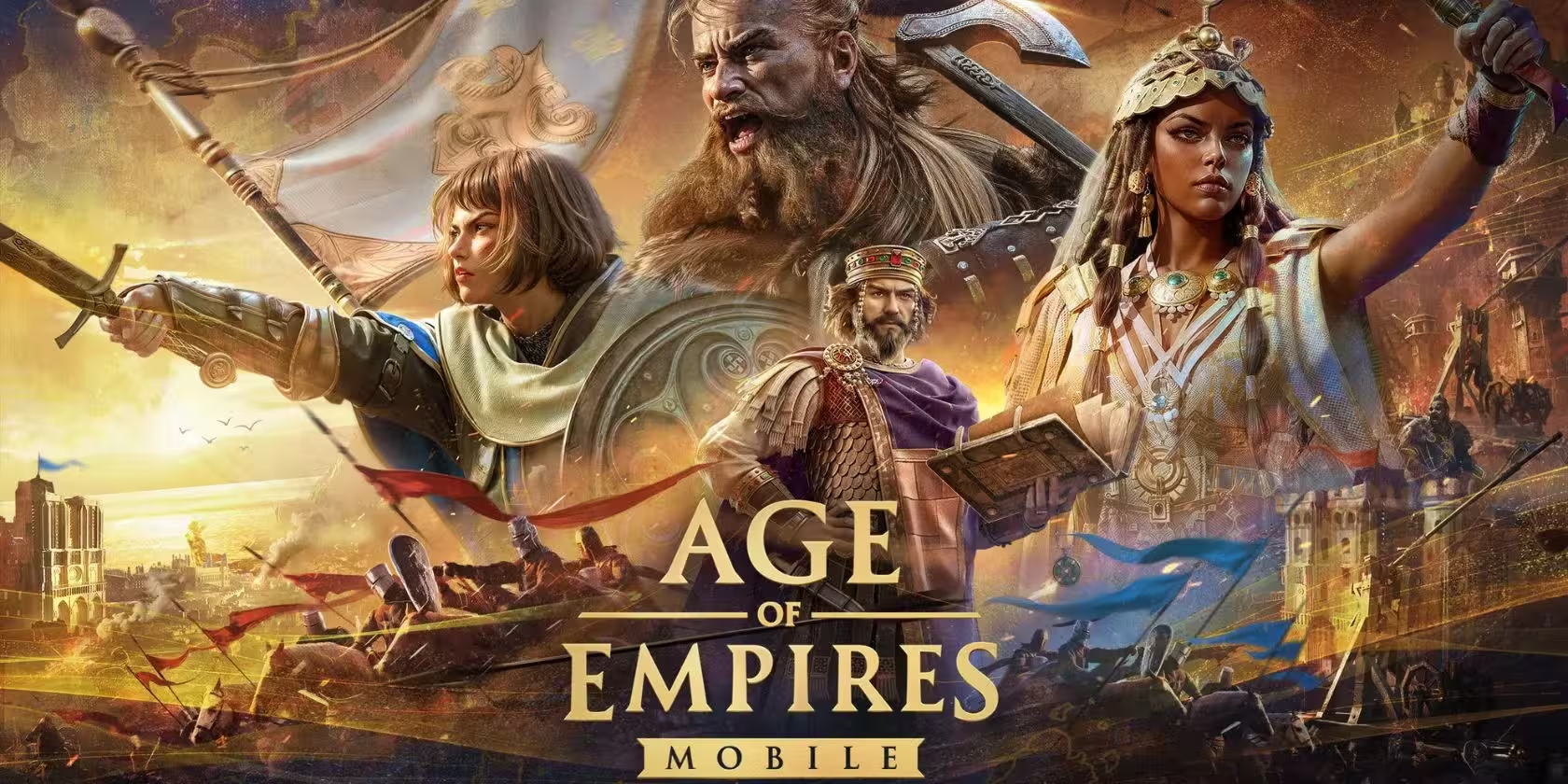
Since it came out in the last week of August, I don’t think I’ve touched any game other than Age of Mythology. It’s just that perfect balance of being an excellent game in its own right and also absolutely nailing the nostalgia for me.
Yeah hopefully that’ll work going forward. Typically it won’t let you see the older content, but hopefully it’ll work to allow you to see any new content from now on.
Hmm, interesting. I don’t know about Mbin, but on Lemmy this sort of thing could be caused if you were on an instance where nobody has subscribed to that community yet. But your instance also has problems with !rpggreentext@ttrpg.network, !vamp_tm@ttrpg.network, and !rpg@ttrpg.network. And even !rpgmemes@ttrpg.network is failing to federate comments. It could be a problem with how Mbin works, or simply caused by nobody on your instance subscribing to those communities. Not sure.
Your instance seems to be failing to federate properly with it. It’s not super active, but it’s much more active than what I see when I view it from your instance.
You talking about pathfinder.social? Yeah as best I can tell, the server is still technically up, but it’s not really functioning correctly, so you just get what looks like an empty Lemmy instance if you go there directly. If you go to !pf2general@pathfinder.social (or one of that instance’s other communities) from your own instance you can browse the old content, but don’t bother with any replies or posts; they’ll seem to work and display to you, but not get sent out to anyone on any other instances.














Basically, “X is one-third more than Y” means either X = (4/3) × Y or X = Y + 1/3. I’m fine with either interpretation.
The problem is that with the values of X and Y in this example, neither interpretation produces a valid equation.